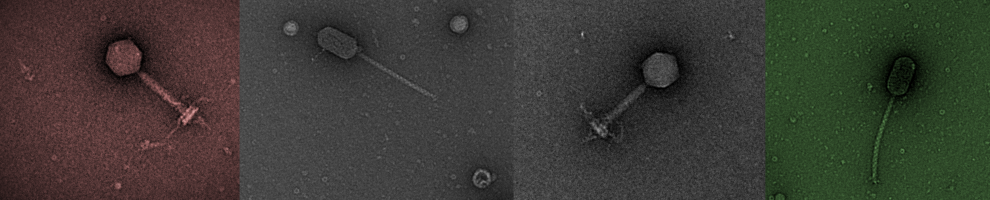
The Millard Lab studies bacteriophages—viruses that infect bacteria—using genomics, viromics, bioinformatics and synthetic biology. We have developed scalable, reproducible approaches to discover, sequence and characterise phages, helping reveal their diversity and supporting new applications.
Phage genomics
We develop computational methods and resources for analysing the rapidly expanding diversity of bacteriophage genomes, including genome comparison, annotation and taxonomy. Recent work includes taxMyPhage, which automates genus- and species-level classification of dsDNA phages.
Phage engineering
We develop and evaluate methods to modify bacteriophages genetically, both to investigate fundamental phage biology and to engineer useful new functions. This includes CRISPR-based engineering of phage T7 and modification of phage surfaces to alter interactions with mammalian cells. T7 engineering · phage-surface modification
Viromics
We use metagenomic sequencing to study complex viral communities across diverse environments. Our work also establishes robust methods for recovering phage genomes, including benchmarking Illumina, Nanopore and PacBio approaches for virome analysis. Read the study
Plaque-2-seq
We developed Plaque-2-seq, a rapid, low-cost workflow for sequencing high-quality phage genomes directly from individual plaques. It enables higher-throughput phage discovery and characterisation. It is the backbone of our recent large scale phage isolation efforts to sequence 10,000 phage isolates as part of a PhageBank